









IN THE NEWS | 27 February 2026 | 18:00 PM SAST
South Africa’s Budget 2026 consolidation narrative strengthens amid Johannesburg fiscal strain, Africa’s $29.5 trillion mineral valuation reshapes industrial ambition, and global markets recalibrate against AI concentration risk and geopolitical trade friction


SOUTH AFRICA | KEY DEVELOPMENTS
Budget 2026 Reaction Cycle Frames Debt Peak Moment
Finance Minister Enoch Godongwana’s 2026 Budget continues to draw structured approval from market economists, with projections placing gross debt at a peak in FY2026 and a consolidated deficit narrowing toward 3.1% of GDP over the medium term. Revenue buoyancy from commodities has enabled upward adjustments to medical tax credits and social grants without introducing new tax instruments, reinforcing a narrative of fiscal consolidation after more than a decade of debt expansion. However, debt-service costs remain elevated at over R400 billion annually, constraining developmental spending, and structural reform in electricity and logistics—particularly private participation in rail and power—remains execution-dependent. The balance between short-term relief and long-term sustainability will shape coalition stability and investor confidence heading into local elections.
Sources: National Treasury – https://www.treasury.gov.za | Bloomberg – https://www.bloomberg.com | Business Day – https://www.businesslive.co.za


Johannesburg Seeks Treasury Support as Service Failures Escalate
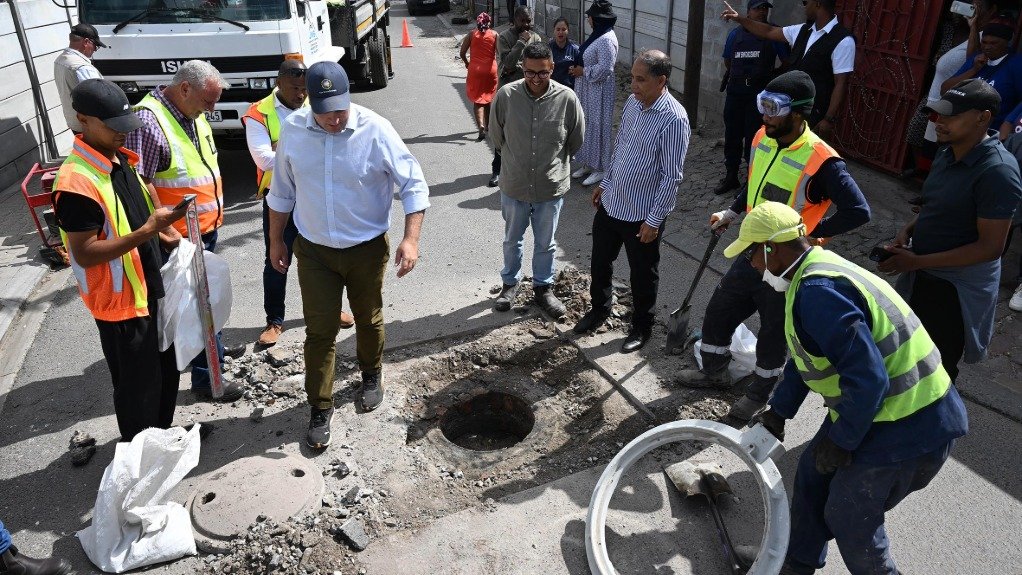
The City of Johannesburg has entered discussions with National Treasury regarding financial stabilisation support amid persistent water supply disruptions and infrastructure deterioration. Minister Godongwana described the metro’s inability to deliver core services as a governance “red flag,” reinforcing concerns about municipal fiscal discipline in Gauteng. With provincial leadership under increasing scrutiny and elections approaching, Johannesburg’s performance has become a proxy for broader metropolitan governance capacity, directly affecting business sentiment in the country’s economic hub.
Sources: National Treasury – https://www.treasury.gov.za | City of Johannesburg – https://joburg.org.za | News24 – https://www.news24.com
DA Leadership Contest Reshapes Opposition Strategy
Cape Town Mayor Geordin Hill-Lewis has confirmed his candidacy to succeed outgoing Democratic Alliance leader John Steenhuisen, setting the stage for a leadership transition that may recalibrate coalition dynamics within the Government of National Unity framework. The contest arrives at a sensitive juncture, as agricultural policy debates and coalition positioning intersect with municipal election strategy. A leadership reset could consolidate the DA’s urban governance brand, but transitional uncertainty risks short-term coordination strain within opposition structures.
Sources: Democratic Alliance – https://www.da.org.za | Reuters – https://www.reuters.com | News24 – https://www.news24.com
Business Contraction and Fintech Growth Signal Divergence
Early 2026 data indicates nearly 100 company closures across sectors, intensifying labour market strain despite improved macro projections. Concurrently, over R600 million in irregular or wasteful expenditure has been flagged in recent audits, underscoring persistent public finance leakage risks even as Treasury outlines R1 trillion-plus infrastructure commitments over three years. In contrast, the prepaid card and digital wallet market expanded approximately 14% year-on-year, reflecting consumer pivot toward digital financial services and signalling structural fintech resilience within a constrained domestic growth environment.
Sources: BusinessTech – https://businesstech.co.za | Auditor-General of South Africa – https://www.agsa.co.za | National Treasury – https://www.treasury.gov.za
AFRICA | KEY DEVELOPMENTS
AFC Study Values Continental Mine-Site Wealth at $29.5 Trillion
A new Africa Finance Corporation assessment estimates Africa’s in-situ mineral value at approximately $29.5 trillion, reinforcing the continent’s strategic leverage in global supply chains spanning rare earths, battery metals, and industrial commodities. At the Africa Trade Summit in Accra, President John Dramani Mahama advocated accelerated beneficiation and cross-border industrial collaboration to secure employment and reduce external dependency. The convergence of resource nationalism and supply chain realignment offers opportunity, but debt sustainability and governance consistency remain decisive constraints on value capture.
Sources: Africa Finance Corporation – https://www.africafc.org | African Union – https://au.int | Reuters – https://www.reuters.com
Sudan Militarisation and South Sudan Political Integration Move in Parallel
Sudan’s military leadership announced plans to expand drone and air defence capabilities following intensified clashes, signalling further entrenchment of a technologically adaptive conflict environment. Simultaneously, South Sudan’s Vice President Riek Machar endorsed expanded opposition inclusion within transitional structures ahead of 2026 elections, reflecting tentative reconciliation efforts. The juxtaposition underscores a regional bifurcation: one trajectory toward militarised consolidation, the other toward negotiated stabilisation, both carrying implications for cross-border security and humanitarian access.
Sources: African Union – https://au.int | Al Jazeera – https://www.aljazeera.com | Reuters – https://www.reuters.com
Electoral Integrity Questions Surface in Nigeria; Italy Deepens Africa Strategy
Allegations that Nigeria’s Electoral Act provisions are being strategically leveraged in by-elections have triggered renewed scrutiny over institutional safeguards, potentially weakening democratic trust in Africa’s largest economy. Concurrently, Italian Prime Minister Giorgia Meloni’s Ethiopia visit reinforced Rome’s Africa policy orientation, emphasising energy partnerships and migration management. The combination of internal governance tests and intensifying external engagement illustrates Africa’s dual reality: institutional fragility amid rising geopolitical courtship.
Sources: Independent National Electoral Commission Nigeria – https://www.inecnigeria.org | Government of Italy – https://www.governo.it | Reuters – https://www.reuters.com
WORLD | KEY DEVELOPMENTS
AI Concentration Risk and Safe-Haven Flows Reshape Markets
Global markets have experienced heightened volatility as investors reassess artificial intelligence-driven equity concentration and geopolitical flashpoints across the Middle East and Asia-Pacific. U.S. Treasuries recorded their strongest monthly performance in a year, reflecting defensive positioning. Analysts warn that outsized weightings in mega-cap technology firms—particularly semiconductor and AI infrastructure leaders—elevate systemic exposure risk if earnings momentum falters. Foreign equity markets outperformed U.S. benchmarks in 2025, partially reflecting policy spillovers and currency adjustments.
Sources: The New York Times – https://www.nytimes.com | Bloomberg – https://www.bloomberg.com | U.S. Department of the Treasury – https://home.treasury.gov
Central Bank Independence Tested Amid Political Pressure
European Central Bank President Christine Lagarde and Federal Reserve Chair Jerome Powell reiterated institutional independence as rate-path debates intensify in election-sensitive environments. The Bank of Japan signalled continued tightening bias despite leadership recalibration, highlighting divergence in global monetary cycles. Preserving policy credibility remains central to inflation anchoring, particularly as fiscal activism expands across major economies.
Sources: European Central Bank – https://www.ecb.europa.eu | Federal Reserve – https://www.federalreserve.gov | Bank of Japan – https://www.boj.or.jp
Tech, Trade, and Strategic Controls Drive Geopolitical Friction
Tensions are escalating around AI defence applications following reports of friction between U.S. defence authorities and private AI developers over military deployment frameworks. Japan’s Rapidus secured significant state-backed financing for 2nm semiconductor production, reinforcing strategic chip sovereignty efforts. Meanwhile, China’s rare earth export controls continue to mature as selective U.S. technology curbs are recalibrated ahead of potential high-level bilateral talks. These developments signal an entrenched techno-industrial competition shaping trade architecture and security alliances.
Sources: U.S. Department of Defense – https://www.defense.gov | Government of Japan – https://www.japan.go.jp | Ministry of Commerce of the People’s Republic of China – http://english.mofcom.gov.cn
UK Political Strain and Asia Fiscal Signals
UK Prime Minister Keir Starmer faces internal party pressure following a by-election setback that reduced Labour’s standing to third place in a contested constituency, raising leadership durability questions. In Hong Kong, the 2026–27 budget projected a modest surplus while reinforcing digital asset and financial hub positioning. India reported approximately 7.5% GDP growth, sustaining its trajectory toward becoming the world’s fourth-largest economy despite currency-related delays in nominal ranking adjustments. Political resilience and fiscal positioning across these jurisdictions will influence capital allocation flows through 2026.
Sources: UK Parliament – https://www.parliament.uk | Hong Kong Government – https://www.gov.hk | Ministry of Statistics and Programme Implementation India – https://www.mospi.gov.in
BOTTOM LINE
| Time horizon: | Last 18 hours |
| Signal strength: | Medium–High |
| Pattern: |
Tactical fiscal stabilisation in South Africa and parts of Africa contrasts with structurally elevated geopolitical and technology-driven volatility globally, reinforcing a 2026 environment defined by consolidation attempts under systemic strain. |
What's Your Reaction?